
Dentist-led smile care · Nizampet, Hyderabad
Oral Surgery Treatment in Nizampet
Concerned about an impacted wisdom tooth, a tooth that may need surgical removal, or another issue affecting your mouth? Start with a dental examination to understand the diagnosis, treatment alternatives, possible risks and expected recovery.
Nizampet Dentist is the Nizampet branch of Dr White Dental Care. Specialist appointments and individual procedures are subject to clinical assessment and availability.
✓ Diagnosis before decisions ✓ Clear recovery guidance ✓ Specialist input when needed
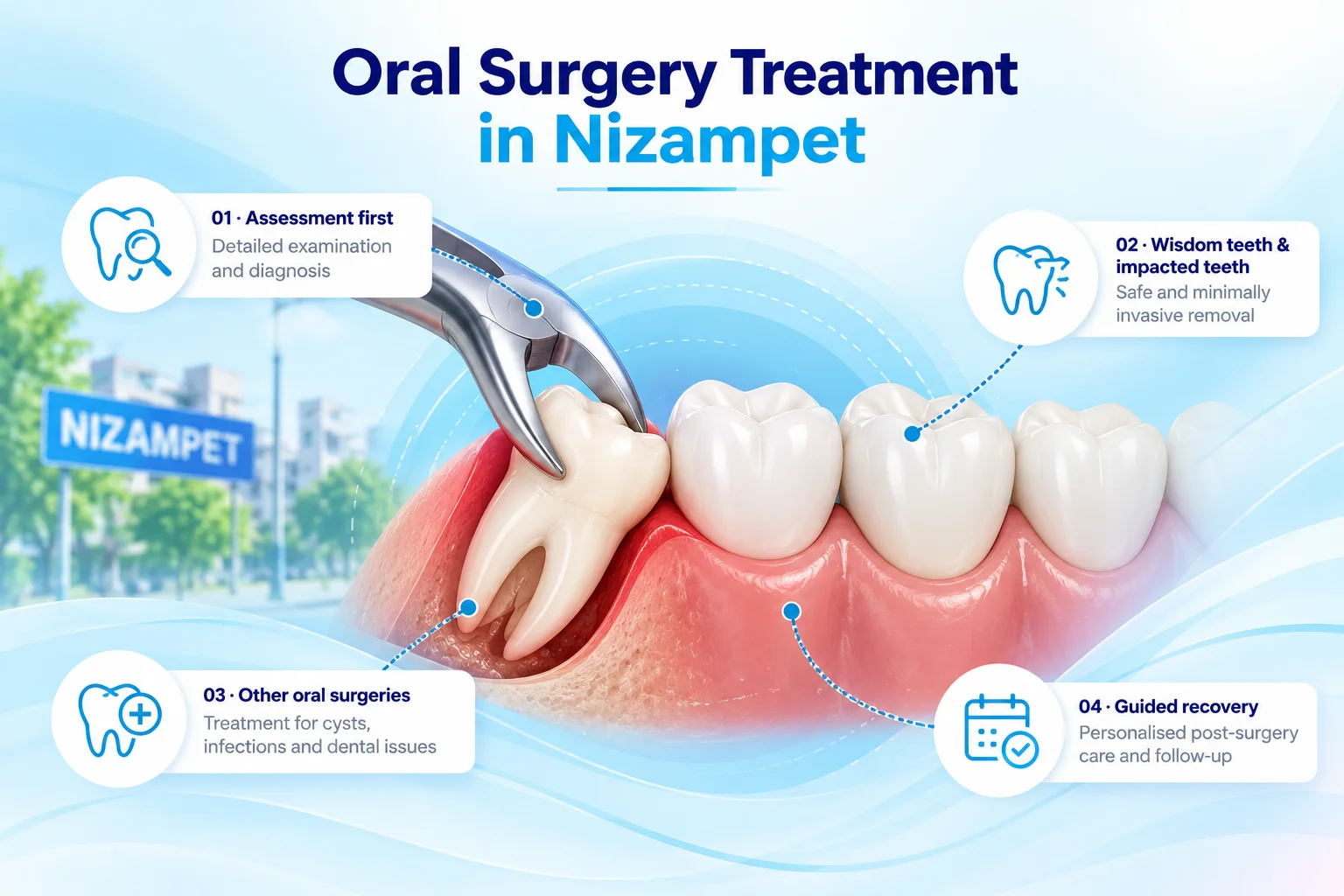
Illustrative dental anatomy only · Diagnosis requires clinical examination and appropriate imaging.
Clinic location
Opposite Balaji Park Town, Nizampet
Clinic hours
Every day · 10 AM – 9 PM
Care pathway
Examination → Options → Plan
Appointments
+91 98480 85789
What Is Oral Surgery?
Oral surgery is a group of procedures used to manage certain conditions of the teeth, gums, jawbone and surrounding oral tissues. Not every toothache or impacted tooth requires an operation; your dentist considers whether treatment, monitoring or a specialist referral is appropriate.
In brief: Oral surgery involves surgical treatment when a dental or oral condition cannot be managed adequately by less invasive care. Common examples include some surgical tooth extractions and removal of problematic impacted wisdom teeth. The required procedure and clinician depend on the diagnosis.
First, understand the cause
Examination, history and dental imaging when indicated help determine why a tooth is painful, difficult to access or affected by infection.
Then compare the options
In some situations a tooth can be preserved with restorative or root canal treatment. Surgery is considered when clinically justified.
Know the recovery plan
Before agreeing to treatment, ask about anaesthesia, limitations, possible complications, review appointments and home-care instructions.
when to seek assessment
When Might Oral Surgery Be Needed?
Symptoms alone do not establish the need for surgery. The following concerns may warrant a dental or oral surgical assessment.
Impacted or problematic wisdom tooth
Pain, recurrent gum inflammation, trapping food, decay or another diagnosed problem may require review. Symptom-free teeth can sometimes be monitored.
Severely damaged or non-restorable tooth
A fractured or extensively decayed tooth may need removal if a clinically suitable repair or root canal option is not available.
Persistent infection or unusual oral lesion
Persistent swelling, root-end problems or an unexplained mouth lesion should be assessed. Treatment could involve medication, root canal care, biopsy or referral.
When not to wait
Swelling, bleeding or severe pain?
Contact the clinic promptly for worsening dental pain, swelling, unexplained bleeding, fever or suspected infection. The team can advise whether urgent clinical review is available.
Emergency warning: difficulty breathing or swallowing, rapidly spreading facial or neck swelling, or major uncontrolled bleeding needs emergency hospital care immediately.
Call Nizampet ClinicTreatment pathways
Oral Surgery Assessments in Nizampet
These are examples of conditions that may lead to an oral surgical opinion. Listing a procedure does not mean it is routinely performed on-site. The clinic should confirm the suitable clinician, facility and availability for your case.
Surgical Tooth Extraction
Considered when a tooth is difficult to remove using a conventional technique, such as a tooth broken below the gum or with complex roots.
Compare extraction approaches →Impacted Wisdom Tooth Assessment
Reviews the tooth’s position, symptoms, surrounding tissues and relationship to nearby structures before discussing monitoring or removal.
Wisdom tooth information →Root-End Infection Assessment
For some persistent root-end problems, nonsurgical root canal retreatment may be considered before an apicoectomy or extraction is discussed.
Root canal information →Oral Lesion Evaluation
An unexplained ulcer, lump or tissue change needs examination. When appropriate, the dentist may arrange specialist opinion and biopsy rather than assume a diagnosis.
Bone and Implant Planning
Missing teeth or reduced bone support may require restorative and surgical planning. Implant placement or grafting suitability is evaluated individually.
Dental implant information →Specialist Referral When Needed
Complex jaw injuries, suspected pathology and higher-risk operations may require a specialist or hospital-based setting. Ask where your treatment would occur.
Clinical note: Pain around a wisdom tooth does not automatically mean extraction is required. The reason for removal should be based on examination and relevant findings, not a routine promise to remove every impacted tooth.
Treatment comparison
Surgical vs Nonsurgical Dental Care
A helpful treatment decision begins with the question: Can the tooth or condition be managed without surgery? The options below are educational, not a substitute for examination.
Concern
Nonsurgical possibility
When surgery might be considered
Deep decay
Filling or root canal treatment if the tooth is restorable
Extraction if damage is beyond predictable repair
Impacted wisdom tooth
Monitoring if there is no disease or other indication
Recurrent infection, decay, pathology or other clinical indication
Persistent root-end problem
Root canal treatment or retreatment, where suitable
Root-end surgery or extraction in selected cases
Missing tooth
Bridge or removable denture
Dental implant placement if suitable and desired
Oral lesion
Clinical observation or medical care if appropriate
Specialist-directed biopsy or treatment when indicated
Decisions depend on the patient’s health, examination, radiographs when needed, condition of the tooth and patient preferences.
Know the difference
Simple Extraction vs Surgical Extraction
Some teeth can be removed without an incision, whereas others require access through gum tissue or separation of the tooth. The choice is based on anatomy and clinical findings.
Feature
Simple Extraction
Surgical Extraction
Common situation
Accessible tooth that can be grasped for removal
Impacted, fractured or difficult-to-access tooth
Gum incision
Usually not required
May be needed for access
Bone removal / tooth sectioning
Typically unnecessary
Sometimes necessary
Local anaesthesia
Often used
Often used; other options depend on case and facility
Recovery
Often less involved
May involve more swelling and recovery care
How selected
By examination and imaging when appropriate, with the relevant risks and alternatives explained
People behind care
Meet the Dental and Specialist Care Team
Oral surgical care should be clearly attributed to an appropriately qualified clinician. The Nizampet branch can confirm who will assess or treat you and whether specialist input or referral is needed.
SL
Dr. Sri Lakshmi Champati
BDS · Dental Surgeon & Implantologist
Founder of Dr White Dental Care, with 13+ years of general, restorative and implant dentistry experience. Initial dental assessment can help determine whether conservative care, extraction or specialist review is appropriate.
About our clinic →TR
Dr. B. Tejaswi Rao
Oral & Maxillofacial Surgeon · Dr White Dental Care
Dr. B. Tejaswi Rao is listed by Dr White Dental Care for oral surgical care such as wisdom tooth assessment and extraction. Please confirm Nizampet consultation availability and which procedures are performed at this branch when booking.
Ask about specialist appointments →Before the procedure
How Is Oral Surgery Planned?
Planning starts with clinical evaluation rather than an immediate decision to operate. A useful consultation explains why treatment is recommended and what alternatives may exist.
Step 01
Understand your concern
Discuss pain, swelling, prior dental care, medical history, allergies and medicines.
Step 02
Examination and imaging
The dentist examines the area and advises on appropriate X-rays or other tests when indicated.
Step 03
Compare treatment options
Review preservation, monitoring, surgery, specialist referral, risks and expected recovery.
Step 04
Consent and preparation
Confirm the clinician, location, costs, anaesthesia plan and individual instructions.
Before your visit: Tell the clinician about anticoagulants, medical conditions, pregnancy, allergies and previous reactions to anaesthesia. Do not stop prescribed medication unless your treating clinician advises it.
08 · Day of treatment
Care should be guided by your procedure, not a generic promise.
For a surgical extraction, the clinician confirms the correct tooth and treatment plan, discusses anaesthesia, performs the planned procedure, checks bleeding control and provides written or verbal home-care instructions.
✓ Ask what sensations to expect during local anaesthesia and what discomfort may follow afterward.
✓ Ask who to call for worsening symptoms, and when follow-up is advised.
A clear step-by-step explanation
What Happens During Oral Surgery Treatment in Nizampet?
For common dental extractions, oral surgery treatment in Nizampet can include the following sequence. More complex oral and maxillofacial surgery may require a different facility or care pathway.
Confirm the agreed treatment
The clinician checks the findings, consent and specific procedure before beginning.
Use the appropriate anaesthesia
Local anaesthetic is commonly used for oral extraction procedures. Suitability and other options are assessed individually.
Perform the planned procedure
Depending on access, this may involve extraction, an incision, tooth sectioning and sutures.
Review bleeding control and aftercare
Follow the individual recovery instructions and know whom to contact if symptoms change.
Patient comfort
Anaesthesia and Comfort During Oral Surgery
For many tooth removals, local anaesthesia reduces pain signals from the treatment area. You may still feel pressure, movement or vibration. Some discomfort, swelling or bruising is possible afterward.
Local anaesthesia
Often used for simple and surgical extractions. The clinician should check numbness before proceeding and explain what you may feel.
Dental anxiety
Discuss fears, prior difficult experiences and the need for breaks. Sedation or other options, if indicated, depend on availability and clinical suitability.
Informed consent
Ask about possible side effects and risks of the chosen anaesthetic, especially if you have relevant medical conditions or medication use.
Pricing clarity
Oral Surgery Cost in Nizampet
There is no single reliable cost for oral surgery treatment in Nizampet. Surgical complexity, imaging requirements, surgeon involvement, treatment setting and follow-up can change the quote.
Quick answer: Oral surgery costs are confirmed after clinical assessment. Ask for an itemised estimate that distinguishes consultation, imaging, the procedure, anaesthesia arrangements and any planned follow-up.
Contact the Nizampet clinic for up-to-date consultation and treatment charges.
Request an individual estimate →Factors that can affect the estimate
✓ Simple or surgical extraction
✓ Tooth position and access
✓ Imaging and investigations
✓ Specialist or hospital involvement
✓ Anaesthesia setting
✓ Sutures, medications and reviews
Before you agree: Ask what is included and whether treatment may change if new findings arise. Availability of financing or insurance reimbursement should be confirmed directly with the clinic.
Recovery guidance
Oral Surgery Recovery and Aftercare
Recovery varies with the treatment and your overall health. This general overview is most applicable to tooth extraction; always follow the clinician’s specific instructions.
First 24 hours
Protect the blood clot
Rest as instructed, manage bleeding using the supplied advice, choose suitable soft foods and avoid smoking or vigorous rinsing. Avoid disturbing the extraction site.
Next several days
Expect some soreness
Mild-to-moderate pain, jaw stiffness and swelling can occur, especially after a difficult extraction. Follow prescribed or recommended pain management instructions.
Follow-up and healing
Check recovery progress
Soft-tissue healing and deeper bone healing take different amounts of time. Contact the clinic for increasing pain, abnormal bleeding, fever or another concerning symptom.
Useful guidance: After extractions, gentle salt-water rinses are often advised from the following day, not immediately after surgery. The exact timing and method should follow your dentist’s instructions. See NHS wisdom tooth removal guidance ↗.
Safety and informed decisions
Possible Risks and When to Seek Help
No surgical procedure is completely risk-free. Your clinician should explain risks specific to the planned treatment, anatomy and health history.
Possible complications to discuss
• Pain, swelling, bruising or temporary jaw stiffness.
• Bleeding or infection after extraction.
• Dry socket if the protective clot is lost.
• Injury to nearby teeth, tissues or nerves in certain cases.
• Altered feeling in the lip, chin or tongue where relevant to lower wisdom teeth.
• Need for additional treatment or specialist referral.
Seek urgent help for
! Bleeding that does not stop with the advised measures.
! Worsening severe pain or swelling, especially with fever or feeling unwell.
! Increasing difficulty opening the mouth or other concerning changes.
! Emergency hospital care: difficulty breathing or swallowing, rapidly spreading facial/neck swelling or major uncontrolled bleeding.
Practical decision example
How a Surgical Decision May Be Made
Instead of making up a patient success story, this educational illustration shows the kind of reasoning a dentist may discuss during an oral surgery consultation.
Illustrative scenario · Not a real patient case
An angled lower wisdom tooth with recurring gum swelling
Concern: Food collects behind the last molar and the gum has become inflamed more than once.
Assessment: A clinician reviews the tooth’s position, gum condition, nearby tooth and relevant imaging, and checks medical history.
Decision: If there is a clear indication, surgical removal may be discussed along with risks, alternatives, expected downtime and surgeon availability. In other circumstances, monitoring may be appropriate.
Examine and investigate
Medical history · oral assessment · imaging if appropriate
Explain the alternatives
Monitoring · conservative care · surgery or referral
Plan recovery and follow-up
Risks · costs · instructions · review arrangements
Local patient care
Why Consider Nizampet Dentist for an Oral Surgery Assessment?
We believe a useful oral surgery visit should make it easier to understand your options, rather than use “best surgeon” claims that are difficult to verify.
Local clinic access
Convenient contact and directions for Nizampet, near Balaji Park Town.
Care-plan conversation
Discuss diagnosis, alternatives, clinical suitability and likely next steps.
Specialist pathway
Ask the team whether your case needs a qualified oral and maxillofacial surgeon or referral.
Clear expectations
Understand costs, possible complications and recovery requirements before treatment.
Patient perspectives
Patient Experiences: What to Look For
When reading a review of surgical dental care, look for specific comments about explanations before treatment, how concerns were handled and whether aftercare information was clear.
Visit the clinic’s Google profile to read first-hand patient reviews, or ask the team about approved surgical cases, where available.
Find Clinic on Google MapsThree questions to ask before booking
✓ Which clinician would carry out the proposed procedure?
✓ Can this procedure be performed at Nizampet, or is another facility required?
✓ How will complications or follow-up needs be managed?
Frequently Asked Questions
01 What is oral surgery treatment?
Oral surgery involves procedures to treat selected dental or oral conditions that require a surgical approach. Examples include surgical extractions and some impacted wisdom tooth removals. Not all dental problems need surgery.
02 Does every impacted wisdom tooth need removal?
No. A symptom-free impacted wisdom tooth may sometimes be monitored. Removal is discussed when there is a clinical indication such as recurrent infection, damage to adjacent teeth or other pathology.
03 Who should perform oral surgery?
The appropriate clinician depends on the procedure’s complexity and risk. Some extractions can be managed by a qualified dentist; complex procedures may require an oral and maxillofacial surgeon or hospital-based care.
04 Is oral surgery painful?
Local anaesthetic is commonly used to reduce pain during dental extraction. You may feel pressure or movement, and discomfort or swelling afterward is possible. Pain and recovery vary by procedure and individual.
05 What is the difference between a simple and surgical extraction?
A simple extraction usually removes an accessible tooth without a gum incision. A surgical extraction may require an incision, limited bone removal or sectioning of the tooth to gain safe access.
06 Can a tooth be saved instead of extracted?
Sometimes. A filling, crown, root canal treatment or retreatment may preserve a restorable tooth. Extraction may be considered when damage or another condition makes preservation inappropriate.
07 How long does oral surgery recovery take?
Recovery depends on surgical complexity and health factors. Pain and swelling after a wisdom tooth operation may improve over several days, while deeper healing takes longer. Your clinician should give case-specific advice.
08 What are possible complications?
Risks can include bleeding, infection, dry socket, swelling and, in some lower wisdom tooth cases, altered sensation related to nearby nerves. Your clinician should explain your individual risks before treatment.
09 What should I do before an oral surgery consultation?
Bring any available dental records and tell the clinician about medicines, allergies, health conditions and previous anaesthetic reactions. Do not stop anticoagulant or other prescribed medicines without medical advice.
10 How much does oral surgery treatment in Nizampet cost?
Cost depends on the clinical procedure, complexity, imaging, anaesthetic arrangement and any specialist involvement. Request a written or itemised estimate after assessment rather than relying on a generic price range.
11 Is an oral and maxillofacial surgeon available at Nizampet Dentist?
The associated Dr White Dental Care team lists Dr. B. Tejaswi Rao as an oral and maxillofacial surgeon. Please call the Nizampet branch to confirm appointment availability and the location where your treatment can be performed.
12 When should I seek emergency help after oral surgery?
Contact a clinician urgently for bleeding that will not stop, worsening swelling or severe pain, particularly with fever. Difficulty breathing or swallowing, or rapidly spreading neck swelling, needs emergency hospital care.
Visit us
Visit Our Dental Clinic in Nizampet
Nizampet Dentist is located on Nizampet Main Road, opposite Balaji Park Town. Patients from Nizampet and nearby areas such as Miyapur, Bachupally and Pragathi Nagar can contact the clinic for directions and appointments.
Nizampet Dentist
Address
1st Floor, House No. 3, 10/2/A, Main Road, opposite Balaji Park Town, Nizampet, Hyderabad, Telangana 500090
Phone
+91 98480 85789
Email
nizampet@dwdc.in
Hours
Monday to Sunday · 10:00 AM – 9:00 PM
Call ahead to verify the appropriate surgeon’s schedule and whether the needed procedure is offered on-site.
Find Us on Google Maps
Opposite Balaji Park Town on Nizampet Main Road, Hyderabad. Open the map for live directions to the clinic.
Open Google Maps ↗Appointment enquiry
Book an Oral Surgery Consultation in Nizampet
Have pain, an impacted tooth or a dental problem that may require surgery? Request a visit so the Nizampet team can confirm a suitable clinician, discuss next steps and arrange an examination.
✓ Clear clinical assessment before surgical decisions
✓ Ask about surgeon availability and procedure setting
✓ Review likely treatment and cost considerations
For difficulty breathing, swallowing or rapidly worsening facial/neck swelling, go to emergency medical services instead of waiting for this form.
Medical disclaimer: This page provides general dental education and is not an individual diagnosis or medical recommendation. Surgical indications, clinicians, risks, costs, sedation arrangements and recovery vary. Always seek an examination and a personalised treatment plan.
Editorial responsibility: Prepared by the Nizampet Dentist Patient Education Team · Updated October 2026. Educational reference: NHS Wisdom Tooth Removal. For clinic details and appointment policies, contact the Nizampet branch.