Home › Blog › Dental Implants For Full Mouth

Clinical review
Reviewed by Dr. Srilakshmi Champati
BDS · Dental Surgeon · Implantologist · Nizampet Dentist, Hyderabad
13+ years of clinical experience. This article provides general patient education about full mouth dental implants; suitability and treatment plans require a clinical assessment.
Full-arch implant guide · Updated October 2026
Dental Implants for Full Mouth: Options, Cost & Treatment
Full mouth dental implants can replace most or all teeth in one jaw or both jaws with a fixed bridge or an implant-retained removable denture. The right plan depends on your bone, gums, bite, medical history, cleaning ability and goals—not simply on how many teeth are missing.
This guide explains All-on-4 and All-on-6, fixed and removable options, treatment stages, costs, healing, risks and the questions worth asking before you choose full-mouth rehabilitation.
A clinical examination is needed to confirm suitability, explain alternatives and provide an individual treatment estimate.
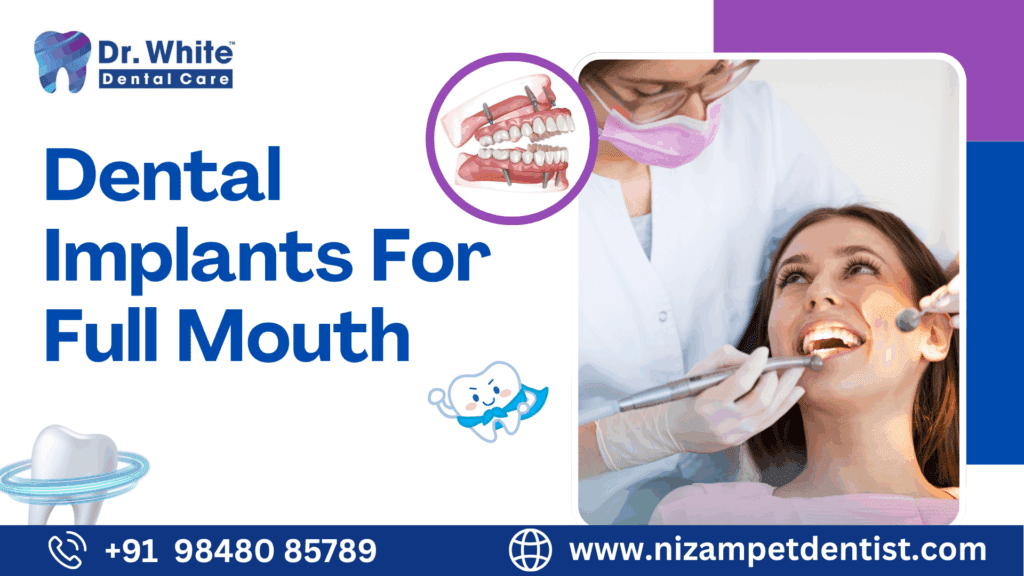
Full-mouth implant treatment is planned for the patient’s anatomy and restoration needs.
The quick answer
Quick Answer: What Are Full Mouth Dental Implants?
Full mouth dental implants replace most or all teeth in the upper jaw, lower jaw, or both. Rather than placing one implant for every missing tooth, a planned number of implants can support a full-arch fixed bridge or an implant-retained removable denture. Four to six implants per jaw are common in selected full-arch plans, but the number and design must be chosen after clinical examination and appropriate imaging.
Fixed or removable
Full-arch treatment may use a bridge that stays in place or a denture that attaches to implants but can be removed for cleaning by the patient.
Not one plan for everyone
Bone shape, gum health, bite, medical history, restoration design and ability to clean under the teeth influence the plan.
Same-day teeth are not guaranteed
Some patients can receive temporary teeth soon after surgery. The final restoration usually follows a healing period.
Key takeaways
Key Takeaways
Full-mouth means one or both arches
The treatment may replace all teeth in the upper jaw, lower jaw or both—not necessarily every tooth with its own implant.
All-on-4 and All-on-6 are approaches
The number of implants is selected from anatomy, implant distribution, bite and the planned restoration.
Planning comes before surgery
Gum health, bone, medical history, medicines, smoking and cleaning needs should be reviewed first.
Temporary teeth differ from final teeth
Immediate or early loading is suitable only for selected cases and depends on clinical stability.
Maintenance continues long term
Implants and the bridge or denture need daily cleaning and regular professional reviews.
Costs need an itemised estimate
Ask what is included: implants, surgery, temporary teeth, final prosthesis, scans, grafting and follow-up.
Full-mouth rehabilitation
What Does “Full Mouth Dental Implants” Mean?
Full-mouth rehabilitation is a treatment plan to replace most or all teeth in the upper jaw, lower jaw or both. Implants are placed in selected positions in the jawbone and then connected to a restoration that replaces the visible teeth.
The restoration may be a fixed full-arch bridge or a removable denture retained by implants. These options differ in stability, cleaning, repair, cost and the way they are supported. A dentist should explain both fixed and removable approaches where they are clinically suitable.
Does every missing tooth need an implant? No. In a full-arch restoration, a carefully planned group of implants may support a connected set of replacement teeth. The number and positions depend on available bone, the shape of the jaw, bite forces, the material and design of the prosthesis, and how the restoration can be cleaned and maintained.
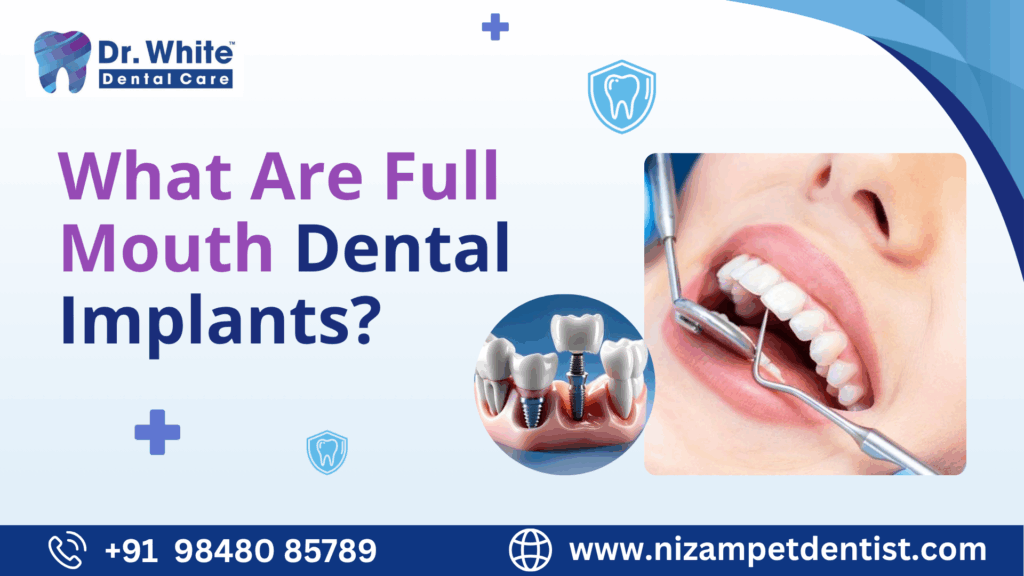
Educational graphic from the Nizampet Dentist website. A consultation determines which full-arch option is appropriate.
Treatment options
Types of Full Mouth Dental Implant Treatment
1. All-on-4 full-arch treatment
A treatment concept in which four strategically positioned implants support a fixed full-arch restoration in selected cases. It may help some patients avoid more extensive grafting, but that is not possible in every mouth. Implant position, bone anatomy, bite and the planned teeth determine whether it is appropriate.
2. All-on-6 full-arch treatment
Uses six implants to support a full arch. Additional implants may provide more support or flexibility in some plans, but six implants are not automatically superior. The decision should account for anatomy, implant distribution, the opposing teeth, prosthesis design and future maintenance.
3. Implant-retained removable denture
Implants help retain a denture that the patient removes for cleaning. It can improve stability compared with a conventional loose denture while allowing the restoration to be removed for hygiene. Attachment systems and cleaning requirements vary.
4. Conventional removable full denture
Rests on the gums and does not require implant surgery. It may suit people who prefer to avoid surgery, need a lower initial-cost approach, or are not suitable for implants. Fit can change as the jaw changes, so adjustments, relining or replacement may be needed.
5. Staged or alternative implant plans
Some patients need extractions, gum treatment, bone grafting or a staged plan before a final bridge can be fitted. People with severe bone loss may need specialist assessment. Do not assume a particular implant system or procedure is suitable before anatomy and medical history are assessed.
All-on-4 vs All-on-6 vs Implant-Retained Dentures
These options solve different needs. A good comparison considers function, cleaning, surgery, maintenance and cost—not only the number of implants.
Feature
All-on-4 fixed bridge
All-on-6 fixed bridge
Implant-retained removable denture
Typical design
Fixed full-arch teeth supported by four implants in selected cases.
Fixed full-arch teeth supported by six implants in selected cases.
Denture attaches to implants and is removed by the patient for cleaning.
Implant count
Four per arch in the named concept; case selection matters.
Six per arch in the named concept; case selection matters.
Varies with jaw, attachment system and plan.
Cleaning
Requires daily cleaning around and under the fixed bridge; professional maintenance is important.
Requires daily cleaning around and under the fixed bridge; professional maintenance is important.
Can be removed for cleaning, but the implant attachments and mouth still need daily care.
Potential advantages
Fixed teeth and a planned full-arch restoration with fewer implants.
Fixed teeth with additional implant support when clinically indicated.
Removable for cleaning; may provide better retention than a conventional denture.
Key considerations
Bone anatomy, implant distribution, bite, prosthesis design and long-term repair.
More implants may affect cost and surgery; suitability depends on anatomy and design.
Attachment maintenance, removal technique, fit and patient preference.
Evidence note: A 2026 systematic review and meta-analysis of 55 studies reported high pooled implant survival for both All-on-4 and All-on-6 at different follow-up periods, while noting substantial study heterogeneity. These results do not establish that one approach is best for every patient. See the 2026 systematic review of All-on-4 and All-on-6 outcomes ↗.
Suitability
Who May Be Suitable for Full Mouth Dental Implants?
Full-mouth implant treatment may be considered for people who have lost most or all teeth, have teeth that cannot predictably be restored, or struggle with an unstable denture. Suitability depends on the individual—not age or the number of missing teeth alone.
Important: A medical condition or bone loss does not automatically rule out implants. It may mean that risks need to be reduced, another clinician involved, treatment staged differently or a non-implant option considered. Never stop prescribed medicines without medical advice.
Factors the dentist will assess
Gum health
Active gum disease may need treatment before implant surgery.
Bone volume and shape
The jaw must provide suitable support, or an additional procedure or alternative plan may be needed.
Medical history and medicines
Diabetes, bone-related medicines, past radiotherapy and other health factors may affect planning.
Smoking and healing
Smoking can impair healing and may increase complications.
Bite and grinding
Clenching, grinding and the opposing teeth affect load on the restoration.
Daily cleaning
You must be able to clean the restoration and attend long-term maintenance.
Expectations and budget
The dentist should explain the stages, alternatives, likely maintenance and costs before consent.
Full Mouth Dental Implant Procedure: Step by Step
Full-mouth treatment is often a staged process. The sequence and number of visits depend on whether teeth need to be removed, whether bone grafting is required and whether a temporary restoration can be safely used.
01
Consultation and examination
Discuss missing or damaged teeth, symptoms, medical history, medicines, smoking, expectations and alternatives.
02
Imaging and planning
The dentist assesses gums, bite and available bone. X-rays or CBCT imaging may be arranged when clinically indicated.
03
Written treatment plan
Review the proposed implant number and position, restoration type, materials, timeline, risks, alternatives and itemised costs.
04
Preparatory treatment
Gum disease, infection or teeth that cannot be retained may need treatment. Bone grafting may be considered when necessary.
05
Implant placement
The implants are placed using appropriate anaesthesia. Surgical details depend on the case and the agreed plan.
06
Temporary teeth, if suitable
Some patients may receive a temporary fixed restoration soon after surgery; others need a different healing plan.
07
Healing and review
The implants need time to integrate with the bone. Follow the prescribed diet, cleaning instructions and review schedule.
08
Final restoration and maintenance
The final bridge or denture is fitted when appropriate. Bite, fit, cleaning access and ongoing maintenance are reviewed.
Can teeth be fitted on the same day? In selected cases, a temporary set of fixed teeth may be attached on the day of surgery or shortly afterwards. This is called immediate or early loading, depending on the timing. It is not the same as completing healing or fitting the final prosthesis. It depends on implant stability, bone, bite, medical factors and the clinician’s protocol.
Timeline
How Long Does Full Mouth Implant Treatment Take?
Many full-mouth implant plans take several months from surgery to the final restoration because bone needs time to heal around the implants. Some patients can use temporary teeth during this period, while others need a staged approach. Extractions, grafting, healing, medical factors and laboratory work can extend the timeline.
Ask for a case-specific timeline and what happens if healing takes longer than expected. Avoid relying on a universal promise such as “fixed permanent teeth in one day.”
Stage
What to expect
Initial assessment
Examination, medical review, imaging if needed, discussion of alternatives and an estimate.
Surgery and early recovery
Swelling, bruising or soreness may occur. Follow the treating clinician’s instructions about rest, food, cleaning and medication.
Healing phase
The implants integrate with bone over time. The length depends on the jaw, bone, procedure and individual healing.
Final teeth
The final restoration is fitted when the clinician considers the implants and tissues ready.
Long-term reviews
Professional maintenance checks the gums, bite, implant components and restoration condition.
Full Mouth Dental Implant Cost in Hyderabad
The cost depends on whether one jaw or both jaws are treated, the number and type of implants, the final teeth material, temporary teeth, extractions, imaging, bone grafting and the complexity of the bite. A quote should state what is included and what could be charged separately.
Treatment option
Published indicative range
Important note
All-on-4 fixed teeth
₹1,50,000–₹2,50,000 per jaw
Indicative range listed on the clinic’s published cost guide; confirm current rates and inclusions.
All-on-6 / full-arch option
₹3,00,000–₹6,50,000 per jaw
Indicative range listed on the clinic’s published cost guide; the clinical plan may differ.
Both upper and lower jaws
Individual written estimate required
Do not assume that a per-jaw price includes both arches, temporary teeth or every additional procedure.
These are published guide ranges, not a personal quotation. Prices and package inclusions can change, so confirm them directly with the clinic before relying on them. Review the Dental Implants Cost in Hyderabad guide for the latest cost breakdown.
What should the estimate include?
✓ Number, brand and model of the implant fixtures.
✓ Surgeon’s fees, anaesthesia and planned surgical procedures.
✓ Temporary restoration, if suitable, and the final bridge or denture.
✓ Abutments, screws, laboratory work and the restoration material.
✓ Consultation, X-rays or CBCT imaging where needed.
✓ Extractions, bone grafting or other additional procedures, if clinically required.
✓ Follow-up appointments, maintenance, repairs, taxes and any exclusions.
Compare fairly
Compare treatment plans by what is included, clinical suitability and long-term maintenance—not just the starting price. Ask for an itemised estimate before consenting to treatment.
Benefits and risks
Benefits, Limitations and Risks
Potential benefits
✓ May provide a more stable tooth replacement than a loose conventional denture.
✓ Can help restore chewing function and appearance for suitable patients.
✓ May allow a fixed restoration that does not need to be removed by the patient.
✓ Implants can help support the bone around their placement sites when integrated, although they do not prevent all changes in the jaw.
✓ May be planned without relying on every neighbouring natural tooth for support.
Limitations and possible complications
! Surgery, healing time and ongoing professional maintenance are required.
! Swelling, bruising, bleeding, discomfort or infection can occur after surgery.
! An implant may fail to integrate with bone or may develop complications later.
! Gum inflammation and peri-implant disease can damage supporting tissues.
! The prosthesis may chip, wear, fracture or need repair; screws and attachments may loosen.
! Bone grafting or additional procedures may be needed in some cases.
! Cleaning under a fixed full-arch bridge can require specific tools and daily attention.
The U.S. Food and Drug Administration advises patients to discuss implant benefits, risks, healing, smoking and long-term care with their dental provider. Read its Dental Implants: What You Should Know ↗ patient guidance.
Recovery and Aftercare for Full Mouth Implants
Follow the instructions provided by the clinician who performs your surgery. The correct routine depends on the procedure, stitches, temporary restoration and your medical history.
During early recovery
✓ Choose soft foods and follow the dentist’s instructions about when to progress your diet.
✓ Take prescribed medicines exactly as directed; do not start antibiotics or stop other medicines without advice.
✓ Follow the recommended cleaning and rinsing routine for the surgical area.
✓ Avoid smoking, which can interfere with healing.
✓ Avoid putting excessive force on a temporary restoration and follow any restrictions on chewing.
✓ Attend planned reviews, even if the area feels comfortable.
Long-term cleaning
✓ Brush twice daily with a soft-bristled toothbrush and fluoride toothpaste, following your dentist’s instructions around the restoration.
✓ Clean under the fixed bridge and around implant attachments with tools recommended for your design.
✓ If you have a removable implant-retained denture, remove and clean it as instructed and clean the implant attachments and gums too.
✓ Attend professional maintenance at the interval recommended for your risk level.
✓ Contact the clinic if the restoration feels loose, your gums bleed or swell, or chewing suddenly feels different.
Get prompt dental advice for increasing pain, swelling, pus, fever, uncontrolled bleeding or a loose-feeling implant or restoration. Difficulty breathing or swallowing, or rapidly spreading facial swelling, requires emergency medical care.
Before you choose
Questions to Ask Before Choosing Full Mouth Implants
Use this checklist during your consultation so you understand the plan, costs and responsibilities before treatment begins.
Why this option?
Why are fixed implants recommended over a removable denture or another reasonable alternative in my case?
How many implants?
Why is this number and distribution appropriate for my bone, bite and planned restoration?
What teeth will I have during healing?
Will a temporary restoration be possible, and what foods or forces must I avoid?
What is included in the price?
Does the estimate cover surgery, temporary teeth, final teeth, scans, grafting and follow-up?
Who will provide each stage?
Who plans the surgery, makes the restoration and manages maintenance or complications?
How will I clean it?
Can the dentist demonstrate how to clean under the bridge or around removable attachments?
What could go wrong?
What are the main risks for me, and what are the alternatives if an implant or restoration fails?
What maintenance will I need?
How often should I return, and what repairs or replacement costs might arise later?
Clinical insight
Plan the Teeth and Cleaning Access Before Choosing Implant Numbers
A full-arch treatment plan should start with the final restoration—not just the surgical procedure. The shape of the new teeth, lip support, smile line, bite, available bone, implant distribution and the space needed for daily cleaning all influence the design. The International Team for Implantology (ITI) consensus guidance also emphasises considering the final prosthetic plan, anatomy, implant distribution and future maintenance when choosing the number and position of implants.
This is why “four implants are enough for everyone” or “six implants are always better” are not reliable rules. The number and positions must fit the individual clinical and restorative plan.
ITI consensus statement ↗Near you
Full Mouth Dental Implant Consultation in Nizampet, Hyderabad
Nizampet Dentist is located on Main Road opposite Balaji Park Town in Nizampet, Hyderabad. Patients from Nizampet and nearby areas such as Miyapur, Kukatpally, Bachupally, Pragathi Nagar and Madinaguda can contact the clinic to ask about a full-mouth implant consultation and appointment availability.
Dr. Srilakshmi Champati, BDS, Dental Surgeon and Implantologist, is listed on the clinic’s published profile with 13+ years of clinical experience. A full-mouth recommendation should follow examination, review of medical history, and appropriate imaging when indicated. The treatment team should explain the options, likely stages, risks and itemised cost before treatment.
Related guides:
Common questions
Frequently Asked Questions
01 What are full mouth dental implants?
Full mouth dental implants replace most or all teeth in the upper jaw, lower jaw, or both using implants to support a fixed bridge or an implant-retained removable denture. The treatment plan depends on bone anatomy, gum health, bite, medical history, cleaning ability and the type of replacement teeth selected.
02 How many implants are needed for a full mouth?
A fixed full-arch bridge is often supported by four to six appropriately positioned implants per jaw, but there is no single number for every patient. Implant number and position depend on the planned teeth, available bone, bite forces, prosthesis design and the clinician’s assessment.
03 What is the difference between All-on-4 and All-on-6?
All-on-4 is a treatment concept that uses four strategically positioned implants to support a full-arch fixed restoration in selected cases. All-on-6 uses six implants. More implants are not automatically better for every patient; the decision should reflect bone, implant distribution, prosthesis design, load and long-term maintenance.
04 Can I get full mouth dental implants in one day?
Some carefully selected patients can receive a temporary fixed set of teeth on the day of implant surgery or soon afterwards. This is often called immediate loading. It does not mean the implants have fully healed or that the final prosthesis is always fitted on the same day. Eligibility depends on implant stability, bone, bite and other clinical factors.
05 How much do full mouth dental implants cost in Hyderabad?
The price depends on whether one or both jaws are treated, the number of implants, implant system, temporary and final teeth, restoration material, imaging and any extractions or bone grafting. Nizampet Dentist’s published cost guide lists indicative per-jaw ranges for All-on-4 and All-on-6; request an updated, itemised estimate after examination before making a decision.
06 Are full mouth dental implants painful?
Implant surgery is performed with appropriate anaesthesia, so pain during the procedure is controlled. Soreness, swelling, bruising or difficulty chewing can occur afterwards. The amount of discomfort and recovery time varies with the procedure and individual health. Follow the treating clinician’s instructions and contact them if symptoms worsen unexpectedly.
07 How long does full mouth implant treatment take?
Treatment often takes several months because the implants need time to integrate with the jawbone before the final restoration is fitted. Some patients can use a temporary restoration during healing, while others need a staged approach. Bone grafting, extractions, healing and medical factors can extend the timeline.
08 Can I get full mouth implants if I have bone loss?
Possibly. A clinical examination and appropriate imaging help assess the amount and shape of available bone. Depending on the case, options may include bone grafting, a different implant position or design, an implant-retained denture, or another treatment. Bone loss does not automatically rule out implants, but it can change the plan.
09 Are dental implants suitable for people with diabetes?
Some people with diabetes can have implant treatment, particularly when their condition is well managed, but healing and infection risks need individual assessment. Tell the dentist about your diagnosis, recent control, medicines and medical team. Do not change prescribed medication without advice from the clinician managing it.
10 Are full mouth implants better than dentures?
Neither option is best for everyone. Fixed implant-supported teeth can feel more stable for chewing, while removable dentures usually involve less surgery and may cost less initially. Implant-retained removable dentures are another option. Your oral health, bone, budget, cleaning ability and preferences should guide the decision.
11 How long do full mouth dental implants last?
Implants can remain functional for many years, but a lifetime result cannot be guaranteed. The bridge or denture attached to the implants may need maintenance, repair or replacement before the implant fixtures do. Daily cleaning, professional maintenance, gum health, smoking, bite forces and medical factors affect long-term outcomes.
12 What are the risks of full mouth dental implants?
Potential risks include swelling, bruising, bleeding, infection, delayed healing, failure of an implant to integrate, nerve or sinus injury in relevant areas, gum inflammation, bone loss, and mechanical issues such as screw loosening or a chipped prosthesis. Your dentist should explain risks and alternatives specific to your case before treatment.
13 Who is not suitable for full mouth implants?
There is no simple checklist that automatically excludes everyone with a particular condition. Active gum disease, uncontrolled medical conditions, smoking, some medicines, limited bone, poor plaque control or difficulty attending maintenance may require treatment, risk reduction or another option first. A clinician must assess your individual circumstances.
14 Where can I discuss full mouth implants in Nizampet?
Nizampet Dentist is on Main Road opposite Balaji Park Town in Nizampet, Hyderabad. Call +91 98480 85789 to ask about a full-mouth implant consultation and current appointment availability. The final recommendation and estimate require an in-person clinical assessment.
Get in touch
Arrange a Full Mouth Implant Assessment
If you are missing most or all teeth, struggle with loose dentures or want to compare fixed and removable options, a consultation can help you understand what is suitable for your mouth. Ask for a written plan that covers alternatives, risks, timeline, temporary teeth, final restoration and maintenance.
Nizampet Dentist
Dr. White Dental Care, Nizampet branch
Address
1st Floor, House No. 3, 10/2/A, Main Road, opposite Balaji Park Town, Nizampet, Hyderabad, Telangana 500090.
Phone
+91 98480 85789
Email
nizampet@dwdc.in
Hours
Monday–Sunday, 10:00 AM–9:00 PM. Confirm appointment availability before visiting.
References and Further Reading
U.S. Food and Drug Administration (FDA) — Dental Implants: What You Should Know ↗
2026 systematic review and meta-analysis — All-on-4 and All-on-6 implant-supported fixed prostheses for the edentulous jaw ↗
International Team for Implantology (ITI) — Number of Implants Placed for Complete-Arch Fixed Prostheses ↗
Indian Dental Association — Consent for Dental Implants ↗
Nizampet Dentist — Dental Implant Treatment in Nizampet
Nizampet Dentist — Dental Implants Cost in Hyderabad
Medical disclaimer: This article is for general dental education and does not replace an examination or personalised advice from a qualified dental professional. Treatment suitability, risks, alternatives, duration, cost and outcomes vary by individual condition. Seek professional care for symptoms or concerns.
Book a consultation
Understand Your Full Mouth Implant Options
Ask about a consultation to discuss bone support, fixed and removable options, treatment stages, current costs and long-term maintenance.
Clinic location
Visit Nizampet Dentist
Address: 1st Floor, House No. 3, 10/2/A, Main Road, opposite Balaji Park Town, Nizampet, Hyderabad, Telangana 500090.
Phone: +91 98480 85789
Call before visiting to confirm appointment availability.
Opposite Balaji Park Town
Nizampet Main Road, Hyderabad. Open Google Maps for live directions to the clinic.
Open Google Maps ↗