Home › Blog › Artificial Intelligence in Dentistry

Clinical review
Reviewed by Dr. Srilakshmi Champati
BDS · Dental Surgeon · Implantologist · Nizampet Dentist, Hyderabad
This article provides general education about the use of artificial intelligence in dentistry. It is not a diagnosis or personalised dental advice.
Dental technology guide · Updated October 2026
Artificial Intelligence in Dentistry: Uses, Benefits and Limitations
Artificial intelligence (AI) in dentistry refers to software that analyses dental images or information to help dentists spot patterns, organise records and support parts of clinical decision-making. It can be useful, but it does not replace a dentist’s examination, professional judgement or discussion with the patient.
From analysing dental X-rays to helping organise clinical notes, AI has several possible uses. The important question is whether a tool is appropriate for its intended task, validated, secure and supervised by a qualified dental professional.
This article describes the technology generally. It does not claim that Nizampet Dentist currently uses any particular AI product. Contact the clinic to confirm which digital tools are available.
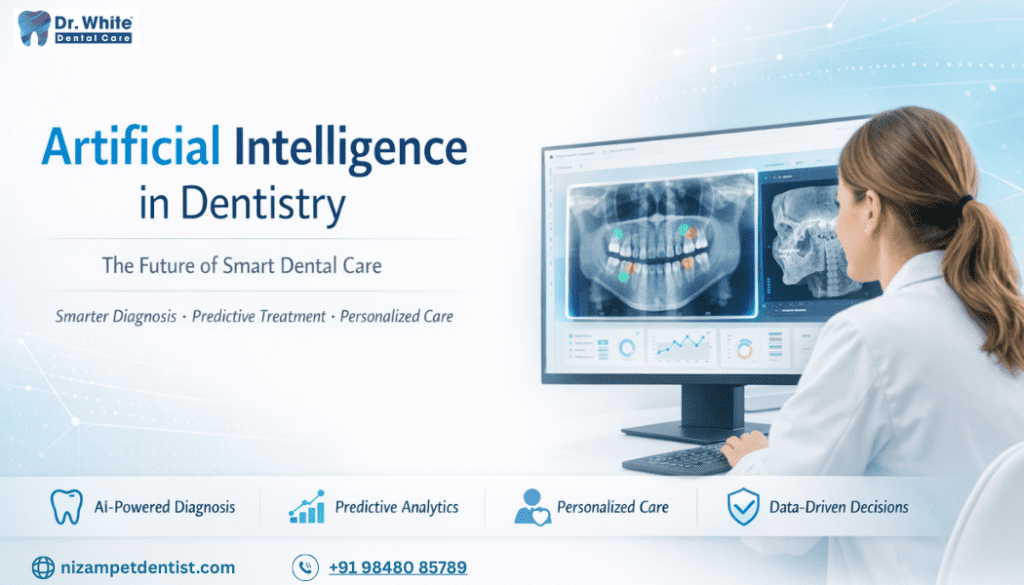
AI may flag patterns in images, while the dentist interprets the result alongside the examination and patient history.
The most important point: AI can help a dentist review information, but a software output is not a diagnosis by itself. The dentist must consider your symptoms, medical and dental history, clinical examination and appropriate tests before recommending treatment.
Where AI is used
Dental image analysis, selected planning tasks, record organisation, patient communication and administrative workflows.
Potential benefit
It can highlight areas for closer review and help organise information, depending on the tool and task.
Important limitation
AI can miss findings or flag normal structures. Dentist oversight, validation and data protection remain essential.
The quick answer
Quick Answer: What Is Artificial Intelligence in Dentistry?
Artificial intelligence in dentistry is the use of computer systems to analyse dental images or clinical information and help with selected tasks. AI may support the review of X-rays, detection of patterns associated with tooth decay or other conditions, orthodontic measurements, treatment-planning workflows and practice administration. It should be used as a support tool—not as an independent replacement for a dentist’s diagnosis, clinical judgement or patient-specific treatment plan.
Patient note: AI is not one single technology. Different systems are built for different tasks, and evidence for one tool cannot automatically be applied to every dental AI product.
Key takeaways
Key Takeaways
AI can analyse patterns
Some systems review X-rays, photographs or scans and flag areas for a dentist to examine more closely.
Applications vary by task
Evidence for image analysis is generally more developed than evidence for autonomous treatment decisions.
People remain responsible
A qualified dentist must interpret AI output in the context of the patient's full clinical picture.
Privacy matters
Dental images and records are sensitive information and should be handled securely and transparently.
The basics
What Does AI Mean in Dentistry?
Artificial intelligence is a broad term for computer systems designed to perform tasks such as recognising patterns, classifying images or processing language. In dentistry, a system may be trained to identify patterns in dental radiographs, measure structures in digital images or assist with routine documentation.
Machine learning and deep learning
Machine-learning systems learn patterns from example data. Deep learning is a type of machine learning often used to analyse complex images. In dental imaging, these systems may highlight a possible finding or produce a measurement for a clinician to verify.
Generative AI and language tools
Generative AI creates or summarises text and other content. In a dental setting, it may assist with drafting patient-friendly explanations, summarising records or preparing routine administrative text. The output can contain errors, so a qualified staff member should check it before it is used for care.
Automation is not always AI
A text reminder sent automatically after an appointment may be simple automation. Software that analyses an image or generates a summary from information is a different type of system. Knowing which task a tool performs makes it easier to judge its usefulness and risk.
Applications
How Is Artificial Intelligence Used in Dentistry?
AI has several possible roles in dental care, from image analysis to administration. The examples below describe what AI may do in each area and what still requires a dentist’s judgement.
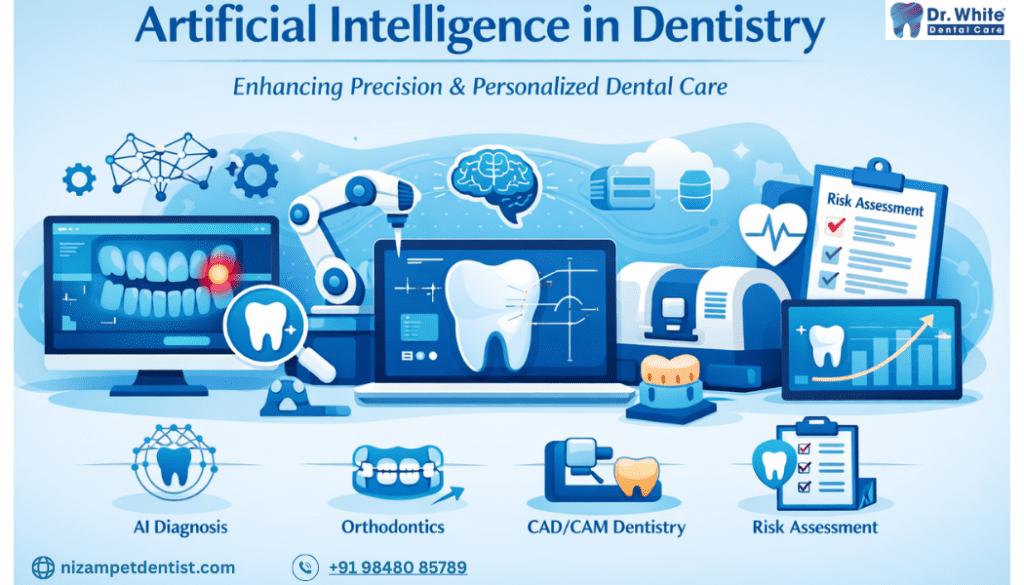
1. Dental X-ray and image analysis
Some AI systems analyse bitewing, periapical or panoramic radiographs and may highlight patterns associated with cavities, changes around tooth roots or bone-level changes. This can help direct attention to areas that need closer review. It does not mean every finding will be detected or that every flagged area requires treatment.
2. Tooth decay detection support
AI tools are being studied and used in selected settings to assist with detecting possible caries on images. Their performance can vary with the type and quality of the image, the population represented in the training data, the stage of disease and the system’s intended use. The dentist still needs to assess the tooth clinically and decide whether monitoring, prevention or treatment is appropriate.
3. Gum and periodontal assessment
Image-analysis tools may help measure or flag changes in bone levels and other patterns relevant to periodontal assessment. Gum disease diagnosis also depends on clinical findings such as gum-pocket measurements, bleeding, tooth mobility and the patient's history. An image alone is not enough to determine the complete diagnosis.
4. Root canal and periapical assessment
AI research includes analysis of images for changes around tooth roots and support for selected endodontic workflows. A dentist must still assess symptoms, pulp status, anatomy, image quality and other clinical factors before recommending root canal treatment or another option.
5. Orthodontic measurements and aligner planning
AI-enabled software can help identify landmarks on orthodontic images, organise digital models and support parts of treatment-planning workflows. The suitability of braces or clear aligners depends on the patient's bite, teeth, gums, jaw relationship and treatment goals. Software-generated measurements do not replace an orthodontic assessment.
6. Dental implant and restorative planning
Digital systems, including some AI-enabled tools, may support image segmentation, measurements or planning workflows for implants and restorations. Implant planning still requires a qualified clinician to assess bone anatomy, health history, the bite, restorative requirements and the risks and alternatives. A software plan is not a guarantee of a particular result.
7. Oral lesion research and image review
Researchers are investigating AI to help analyse photographs and images of oral lesions. This is a sensitive area: a concerning lesion must be assessed by a qualified clinician, and any indicated referral, biopsy or further investigation should not be delayed because of an AI result.
8. Records, notes and practice administration
AI-enabled tools may assist with drafting notes, organising information, summarising records, appointment workflows or routine communication. These tasks can save administrative effort, but information must be checked for accuracy and sensitive patient data should not be entered into unapproved consumer tools.
9. Patient education and communication
AI may help turn technical information into simpler explanations or prepare educational material. Dentists and staff should verify the content, ensure it reflects the actual treatment plan and make clear when a response is general information rather than personal medical advice.
AI applications at a glance
AI application
Possible role
What still needs human judgement
Dental X-ray analysis
Highlight patterns or areas for closer review.
Confirm findings using clinical examination, history and suitable tests.
Caries and gum assessment
Support image interpretation or measurements.
Decide whether a finding is clinically meaningful and what care is needed.
Orthodontic workflows
Assist with landmarks, measurements and digital planning.
Assess bite, jaw relationships, oral health, patient goals and treatment suitability.
Implant and restorative planning
Support selected image or digital-model tasks.
Evaluate anatomy, risks, restorative needs, alternatives and informed consent.
Documentation and communication
Draft or summarise routine text.
Check facts, correct errors and protect confidential information.
Current research
What Does the Current Research Say?
Research in dental AI is growing, but the strength of evidence differs across applications. A September 2026 evidence and gap map in BMC Oral Health included 155 systematic reviews and meta-analyses. It found that the evidence base was concentrated in diagnosis and detection, while synthesized evidence was less developed for some areas of treatment planning, rehabilitation and therapy.
A 2026 review in the Journal of Applied Dentistry and Oral Sciences also described promising uses in image analysis and selected planning tasks, while noting limitations such as retrospective study designs, insufficient external validation, population bias and uncertainty about performance in real-world settings.
How to interpret this: A high score in a research test does not automatically prove that a tool improves patient outcomes in every clinic. Useful evidence should show that the system works for its intended purpose, in relevant settings, and adds value to clinical care.
Read the research: BMC Oral Health evidence and gap map (2026) ↗ and 2026 review of current evidence, clinical utility and challenges ↗.
Potential benefits
Potential Benefits of AI in Dentistry
May help draw attention to overlooked details
For some image-analysis tasks, a system can highlight a pattern that the dentist can then review. This may be useful as an additional prompt, not as proof that a disease is present.
Can support consistency in selected tasks
Software can apply the same programmed analysis process across images. Consistency is useful only when the tool has been properly validated and the images and clinical context are suitable.
May help organise information
Documentation and administrative tools may reduce repetitive work when outputs are accurate, checked and securely managed. This can give staff more time for patient-facing tasks, depending on the workflow.
Can make some explanations easier to understand
AI may help prepare plain-language summaries or visual explanations, but the dentist should verify that the explanation is correct and matches the individual patient's situation.
Important distinction: Potential efficiency or technical accuracy does not automatically mean fewer appointments, lower treatment costs, less pain or better long-term outcomes. Those benefits must be demonstrated for the particular tool and use case.
Know the risks
Limitations and Risks of AI in Dentistry
False positives and missed findings
An AI system may flag an area that is not diseased or fail to highlight a real problem. Both errors matter: false alarms can lead to unnecessary worry or additional investigations, while missed findings can delay care if the result is trusted without proper review.
Performance may vary between people and settings
A system trained on one dataset may perform differently with other populations, imaging equipment, image quality or clinical settings. Independent validation is important before a tool is relied upon in a new environment.
Limited explanation of how a result was reached
Some systems provide a score or highlighted area without making the reasoning fully understandable. Dentists need to know the tool's intended use, known limitations and how its output should influence a decision.
Privacy and confidentiality
Dental records may contain names, contact details, radiographs, facial images, health history and treatment information. Clinics should understand how a tool stores and processes information, who can access it, whether data may be reused, and what permissions and safeguards apply.
Overreliance and unnecessary treatment
AI should not be treated as an automatic instruction to drill, extract, prescribe or perform another procedure. A finding must be interpreted in the patient's clinical context, and treatment options should be discussed with the patient.
Cost, training and workflow fit
AI tools can involve software fees, equipment requirements, staff training and changes to existing workflows. Buying a product does not by itself establish that it is clinically useful or cost-effective for a particular practice.
Accountability remains important
Clinicians and practices need clear processes for reviewing outputs, documenting relevant decisions, handling errors and explaining the role of AI to patients. AI does not remove the need for professional responsibility.
The dentist’s role
Can AI Replace a Dentist?
No. AI can assist with selected tasks, but it cannot independently replace the full process of dental care. A dentist combines symptoms, medical history, examination findings, diagnostic tests, patient preferences, practical constraints and professional experience to make recommendations.
Even when AI flags a possible problem, a dentist must determine whether the finding is real, whether it needs treatment now, whether monitoring or prevention is appropriate, and what options best fit the patient. The dentist should explain the reasoning and answer questions before treatment decisions are made.
Clinical insight
Technology Should Support the Patient, Not Lead the Decision
The practical value of AI is not that it makes a decision automatically. Its value is whether it helps a qualified dentist review relevant information, explain the findings and choose an appropriate plan with the patient. If an AI result conflicts with the examination or the patient's symptoms, the discrepancy needs professional assessment rather than automatic acceptance of the software output.
What Should You Ask Your Dentist About AI?
If a clinic tells you it uses AI, these questions can help you understand the role of the technology:
01
What does the tool do?
Ask whether it analyses images, supports measurements, prepares notes or performs another specific task.
02
Who checks the result?
Confirm that a qualified dentist reviews the output and makes the clinical decision.
03
How reliable is it for my case?
Ask about the tool's intended use, known limitations and whether the image or task is suitable.
04
How is my data protected?
Ask how records are stored, who can access them and whether your information is used for other purposes.
05
Will it change my treatment or cost?
Ask what the result means for your options, fees and any additional tests or appointments.
06
Can you explain the finding without AI?
You should receive a clear explanation of the diagnosis, alternatives, risks and next steps.
What Responsible Dental AI Use Looks Like
Task-specific validation
The tool has evidence supporting the particular task for which it is being used.
Clinical oversight
A dentist interprets the result alongside the patient's history, examination and relevant tests.
Transparency
Patients can understand what the tool contributes and what it cannot establish.
Privacy safeguards
Sensitive data is handled through approved systems with suitable access and security controls.
Bias and error monitoring
Practices and vendors have processes to identify limitations and review problems.
Clear accountability
Clinical decisions remain the responsibility of the treating professional, not an unexplained software output.
The American Dental Association's AI standards work emphasises safety, efficacy, transparency and fairness. The World Health Organization's guidance on AI for health likewise highlights autonomy, safety, transparency, accountability, inclusiveness and sustainability.
Sources: American Dental Association — Artificial Intelligence in Dentistry ↗ and World Health Organization — Ethics and Governance of AI for Health ↗.
Looking ahead
The Future of Artificial Intelligence in Dentistry
Research is exploring more integrated analysis of dental images, digital scans, records and patient-reported information. Future systems may help clinicians compare changes over time, plan complex care or communicate findings more clearly. These are areas of development, not guarantees of what every clinic can provide today.
Progress will depend on diverse and well-labelled datasets, independent testing, prospective studies, clear reporting of limitations, secure data practices and evidence that the technology improves decisions or outcomes in real clinical settings. New features should be evaluated on their actual performance—not just on marketing claims.
What Patients in Nizampet Should Know
For patients in Nizampet and nearby Hyderabad areas, the most useful question is whether any digital tool used during a dental visit adds reliable information to the clinical examination. AI is not necessary for every diagnosis or treatment, and a clinic can provide appropriate care without using an AI product for a particular task.
Nizampet Dentist is located on Main Road, opposite Balaji Park Town, Nizampet, Hyderabad. If you have a dental concern, contact the clinic to ask about an assessment and the diagnostic methods available. This article does not verify or claim that the clinic currently uses AI-based diagnostic systems.
Common questions
Frequently Asked Questions About Artificial Intelligence in Dentistry
01 What is artificial intelligence in dentistry?
It is the use of computer systems to analyse dental images or information and assist with selected tasks, such as image review, measurements, documentation or communication. It supports dental professionals rather than replacing a full clinical assessment.
02 How is AI used in dental X-rays?
Some systems analyse X-rays and highlight patterns that may relate to tooth decay, changes around roots or bone levels. A dentist must confirm the significance of a finding using the patient's history, examination and appropriate tests.
03 Can AI detect cavities?
Some AI systems are designed to help identify possible cavities on dental images. Performance varies by tool, image quality and clinical setting, so the result should be interpreted by a dentist rather than treated as a diagnosis on its own.
04 Can AI replace a dentist?
No. AI does not replace a dentist's full examination, clinical judgement, discussion of patient preferences or responsibility for diagnosis and treatment decisions.
05 Is AI in dentistry accurate?
Accuracy varies by task and system. Results from controlled research do not automatically establish performance in every clinic or population. Independent validation and clinical oversight are important.
06 Is AI used in orthodontics and clear aligner treatment?
AI-enabled software may assist with orthodontic measurements, digital models and parts of planning workflows. Treatment suitability still depends on a dentist's or orthodontist's assessment of the bite, teeth, jaw relationships and oral health.
07 Can AI help with dental implant planning?
Some digital workflows use AI-enabled analysis to support image measurements or planning. Implant decisions require professional evaluation of anatomy, medical history, restorative needs, risks and alternatives.
08 Does AI make dental treatment cheaper?
Not necessarily. Costs depend on the clinic, procedure, technology and individual case. AI may change some workflows, but it does not guarantee lower fees or fewer appointments.
09 Is it safe to upload my dental X-ray to a public AI chatbot?
Do not upload identifiable dental images or health information to a public AI tool unless you understand its privacy terms and have appropriate permission. Ask your clinic how approved systems protect and process patient information.
10 Can AI diagnose oral cancer?
AI image analysis for oral lesions is an active research area, but it cannot independently rule out cancer. Any persistent, suspicious or changing oral lesion should be assessed by a qualified clinician, with referral or biopsy when indicated.
11 Is AI already used in every dental clinic in India?
No. Adoption varies by clinic, software, equipment, resources and clinical task. Ask a specific clinic which tools it uses and how a dentist reviews their results.
12 What should I ask if my dentist uses AI?
Ask what the tool is designed to do, who reviews its output, how reliable it is for your case, how your data is protected and whether it changes your treatment options or costs.
Get in touch
Have a Dental Question? Contact Nizampet Dentist
If you need an examination or want to understand the diagnostic methods available for your concern, contact the clinic directly. A dentist can explain which tests are appropriate for your case and what the findings mean.
Nizampet Dentist
Address
1st Floor, House No. 3, 10/2/A, Main Road, opposite Balaji Park Town, Nizampet, Hyderabad, Telangana 500090.
Phone
+91 98480 85789
Email
nizampet@dwdc.in
References and Further Reading
This article uses current professional guidance and published research to explain the potential and limitations of dental AI. Evidence and products continue to evolve.
American Dental Association — Artificial Intelligence in Dentistry and AI standards ↗
Krishna D, Ramanarayanan V. Applications of artificial intelligence in dentistry: an evidence and gap map analysis. BMC Oral Health, September 2026. ↗
Rajan PT, Anuradha P. Artificial Intelligence in Dentistry: Current Evidence, Clinical Utility, and Challenges. 2026. ↗
Ma Z, et al. Generative Artificial Intelligence: Applications and Future Prospects in Dentistry. International Dental Journal, February 2026. ↗
World Health Organization — Ethics and Governance of Artificial Intelligence for Health ↗
International Association for Dental, Oral, and Craniofacial Research — Policy Statement on Ethics in AI, 2026 ↗
Medical disclaimer: This article is for general education only and is not a diagnosis or a substitute for personalised dental advice. The presence or absence of AI does not determine the quality or suitability of an individual treatment plan. Ask a qualified dental professional about your specific needs.
Book a consultation
Understand Your Dental Care Before Making a Decision
Digital tools can support selected dental tasks, but your treatment plan should be based on a professional assessment, clear explanations and a discussion of options.
Clinic location
Visit Nizampet Dentist
Address: 1st Floor, House No. 3, 10/2/A, Main Road, opposite Balaji Park Town, Nizampet, Hyderabad, Telangana 500090.
Phone: +91 98480 85789
Opposite Balaji Park Town
Nizampet Main Road, Hyderabad. Open Google Maps for live directions to the clinic.
Open Google Maps ↗