Artificial intelligence in dentistry
Artificial Intelligence in Dentistry: The Future of Smart Dental Care
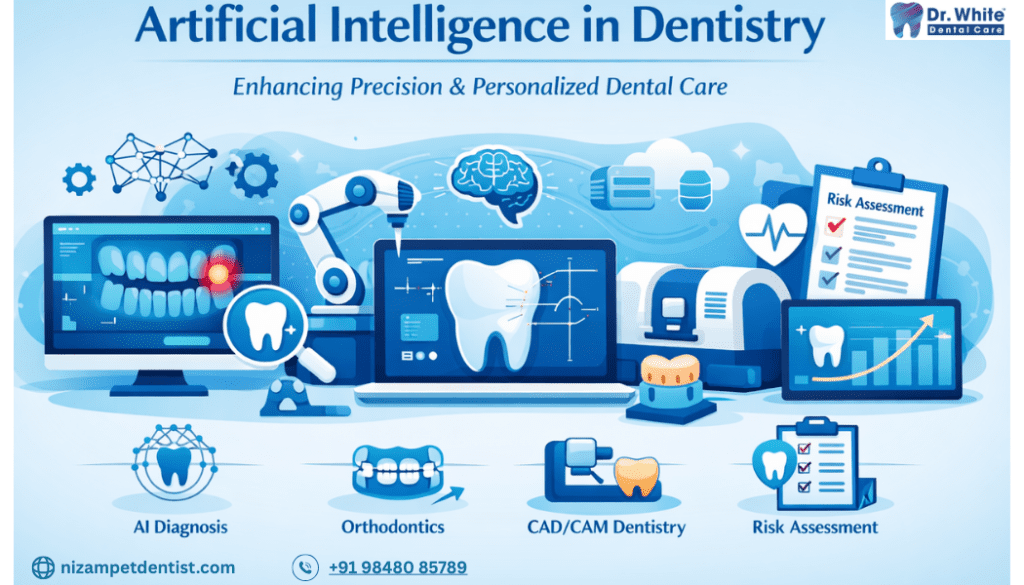
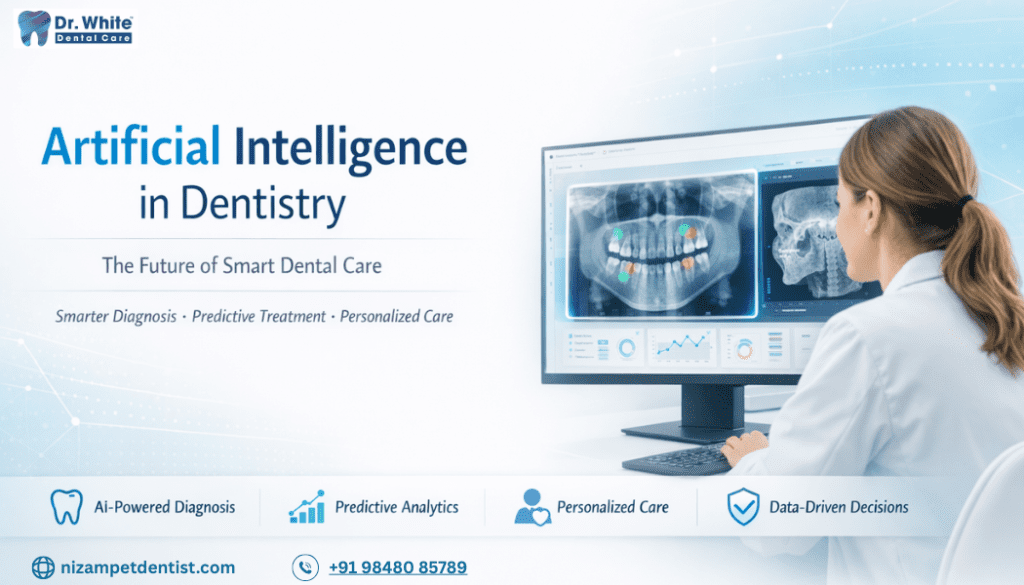
Artificial intelligence in dentistry is redefining modern dental care by combining clinical expertise with advanced data-driven technology. From highly accurate imaging analysis to predictive treatment planning, AI-powered dentistry enhances precision, efficiency, and patient safety. Today’s intelligent systems can detect dental caries, periapical lesions, bone loss, and complex canal anatomy on 2D and 3D radiographs with impressive accuracy. In orthodontics and surgery, AI supports cephalometric tracing, tooth segmentation, and outcome prediction, while in prosthodontics, CAD/CAM integration improves crown design and reduces laboratory time.
Beyond clinical applications, artificial intelligence in dentistry also strengthens preventive care, patient communication, and administrative workflows such as scheduling and billing. In pediatric dentistry, AI enables early cavity detection and growth monitoring for better long-term outcomes. As the field advances toward multi modal AI combining imaging with clinical data dental care is becoming more personalized than ever. The future of dentistry is intelligent, efficient, and patient centered.
What is Artificial Intelligence in Dentistry?
Artificial intelligence in dentistry refers to the use of machine learning algorithms and data-driven systems that assist dentists in diagnosis, treatment planning, imaging analysis, and patient management.
AI-powered dentistry works by analyzing large volumes of clinical data such as:
Dental radiographs
- CBCT scans
- Intraoral scans
- Clinical photographs
- Patient medical histories
These systems learn patterns from thousands of cases and help dentists make faster, more accurate decisions using clinical decision support systems.
Modern digital dentistry and AI together create what we call smart dentistry technology where diagnostics are data driven and treatment is more predictable.
Use of AI in Dentistry – How It Works in Modern Dental Hospitals
Artificial intelligence is now integrated into almost every department of a modern dental hospital.
AI in Imaging & Diagnosis
One of the most impactful applications of artificial intelligence in dentistry is in imaging and diagnosis.
AI models demonstrate high precision — often greater than 90% accuracy — in identifying:
- Dental caries
- Periapical lesions
- C shaped canals
- Bone loss patterns
These detections occur on both 2D radiographs and 3D scans such as Cone beam computed tomography and Panoramic radiography.
AI systems developed by companies like Overjet and Pearl assist dentists by highlighting suspicious areas on X-rays, reducing the risk of missed diagnoses.
Why This Matters for Patients
- Early cavity detection
- More accurate gum disease assessment
- Clear visual explanations
- Reduced diagnostic errors
Yes — AI can read dental X-rays, but it works as a second set of intelligent eyes, supporting your dentist’s clinical judgment.
Orthodontics & Surgery: Precision Through Prediction
Artificial intelligence is transforming orthodontics and surgical planning.
AI helps with:
- Cephalometric tracing
- Tooth segmentation
- Predicting treatment outcomes
- Jaw growth pattern analysis
By using predictive dental analytics, AI-assisted orthodontics can forecast how teeth will move over time, improving aligner and brace planning.
In surgical cases, AI supports implant positioning, bone density evaluation, and anatomical risk assessment — improving safety and precision.
This level of data-driven planning reduces treatment surprises and improves long-term outcomes.
Prosthodontics: Smarter Crowns with AI + CAD/CAM
In prosthodontics, AI integrates with CAD/CAM systems to improve crown and bridge design.
AI-enhanced CAD/CAM technology:
- Improves crown margin accuracy
- Optimizes occlusion design
- Reduces laboratory turnaround time
- Enhances digital smile design precision
Manufacturers like Dentsply Sirona have contributed to integrating smart algorithms into restorative workflows.
Preventive & Public Health Applications
Artificial intelligence is not limited to individual patient care — it also contributes to preventive dentistry and public health.
AI algorithms can:
- Predict disease progression
- Identify high risk patients
- Assist in population level screening
- Monitor periodontal disease trends
By analyzing historical patient data, AI can forecast the progression of conditions like Periodontal disease and help intervene early.
Preventive dentistry becomes proactive instead of reactive.
Artificial Intelligence in Pediatric Dentistry
Artificial intelligence in pediatric dentistry is particularly valuable because early detection is critical in children.
Early Cavity Detection in Children
AI systems assist in identifying early-stage lesions, including Early childhood caries, before they become painful or complex.
This enables:
- Minimally invasive treatment
- Reduced discomfort
- Shorter chair time
- Better long-term oral health
Behavior-Friendly and Faster Diagnosis
Children often experience dental anxiety. AI-supported imaging allows:
- Faster scan analysis
- Fewer repeat radiographs
- Clear visual explanation for parents
This improves trust and reduces fear during appointments.
AI in Growth Monitoring & Orthodontics
AI-assisted orthodontics in children helps monitor jaw development and tooth eruption patterns. Predictive analytics can determine whether early intervention is needed.
This prevents more complex orthodontic issues later in life.
Is AI safe for children?
Yes — AI analyzes existing imaging data; it does not expose children to additional radiation.
AI-Enhanced Communication & Patient Education
Modern AI tools are improving how dentists communicate with patients.
AI systems visually mark areas of concern on radiographs, helping patients understand why treatment is necessary.
Benefits include:
- Increased treatment acceptance
- Better patient education
- Improved trust
- Transparent care planning
When patients clearly see their condition, they make more informed decisions.
Administrative Automation: Beyond Clinical Care
Artificial intelligence in dentistry also enhances operational efficiency.
AI helps with:
- Smart appointment scheduling
- Automated patient billing
- Managing medical histories
- Insurance documentation support
Integration with dental software systems like Dentrix improves workflow automation.
This reduces administrative errors and shortens waiting times.
Benefits of Artificial Intelligence in Dentistry for Patients
The benefits of artificial intelligence in dentistry go beyond technology — they directly impact patient outcomes.
1. Higher Diagnostic Accuracy
AI models often exceed 90% precision in detecting cavities and lesions.
2. Early Disease Detection
Conditions are caught before symptoms worsen.
3. Personalized Treatment Plans
Future-forward systems are shifting toward multi-modal AI, combining imaging data with clinical and medical history for customized care.
4. Faster Appointments
Automated charting and imaging reduce chair time.
5. Improved Transparency
Visual AI overlays make treatment necessity easier to understand.
6. Long-Term Cost Savings
Early intervention prevents complex and expensive procedures later.
We are here
Enquire Now
FAQ
Artificial intelligence in dentistry is used to analyze dental X-rays, CBCT scans, and intraoral images to detect conditions such as cavities, bone loss, periapical lesions, and root canal anatomy variations. AI acts as a diagnostic support system, improving accuracy and reducing missed findings.
AI systems can detect:
- Dental caries (tooth decay)
- Periapical infections
- Periodontal bone loss
- C-shaped canals
- Impacted teeth
- Early orthodontic irregularities
Many AI tools demonstrate high diagnostic precision, often exceeding 90% accuracy in radiographic analysis.
Yes. AI improves workflow efficiency by automating radiograph analysis, treatment planning suggestions, and administrative processes like scheduling and billing. This reduces chair time and speeds up overall treatment delivery.
Advanced AI systems use predictive analytics to assess disease progression risk. By analyzing patient history and imaging data, AI can identify patients at higher risk for gum disease, cavities, or orthodontic issues before they become severe.
Initially, AI technology requires investment from dental hospitals. However, for patients, AI often reduces long-term costs by enabling early detection and preventing complex treatments.
AI assists with cephalometric tracing, tooth segmentation, and predicting treatment outcomes. It helps orthodontists simulate tooth movement and create more precise aligner or braces treatment plans.
Reputable dental hospitals use encrypted systems and comply with healthcare data protection regulations. Data privacy and ethical AI implementation are critical considerations in modern AI-powered dentistry.
Multi-modal AI combines multiple data sources — such as imaging, clinical examination findings, and medical history — to provide more personalized and accurate treatment recommendations. This represents the future direction of artificial intelligence in dentistry.
Yes. AI algorithms can identify early warning signs of oral diseases and assist in population-level screening programs, helping prevent disease progression through timely intervention.
No. AI enhances dental professionals’ decision-making but does not replace clinical expertise, patient interaction, or hands-on procedures. Dentistry remains a human-centered profession supported by intelligent technology.
Artificial intelligence in dentistry enhances radiology by analyzing 2D and 3D scans such as panoramic X-rays and CBCT images with high precision. AI systems highlight areas of concern like cavities, bone loss, and periapical lesions, helping dentists reduce diagnostic errors and improve treatment confidence.
Yes. AI algorithms can identify early signs of periodontal bone loss and gum inflammation by analyzing radiographic patterns and patient history. Early detection allows preventive intervention before the condition progresses to advanced periodontal disease.
AI supports dentists by predicting treatment outcomes, analyzing tooth movement in orthodontics, and assisting in implant positioning. By using predictive analytics, artificial intelligence helps create more personalized and data-driven treatment plans.
Yes. AI can detect complex canal anatomies such as C-shaped canals and periapical infections on radiographs. This helps dentists plan more precise root canal treatments and reduces the risk of missed canals.
AI enhances digital smile design by analyzing facial proportions, tooth alignment, and bite relationships. When integrated with CAD/CAM systems, AI improves crown design accuracy, aesthetic planning, and overall treatment predictability.